

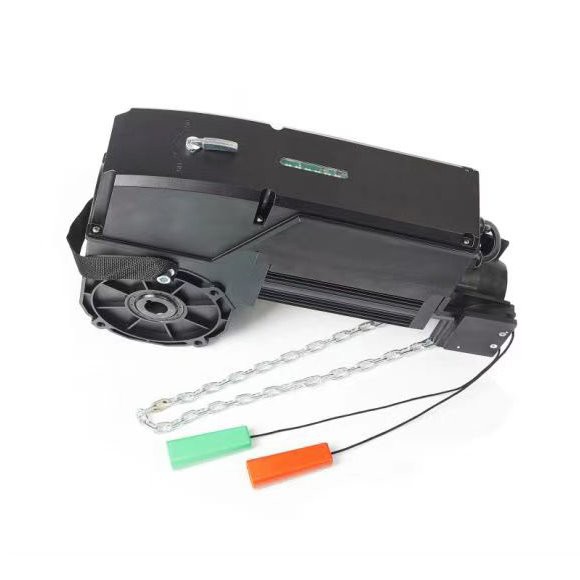
Specification
|
Item No. |
Output torque |
Rate speed |
Maximum number of output shaft revolutions |
Maximum weight of the door leaf. |
Voltage |
Power |
Gearbox Ratio |
Protection class |
Maximum time of continuous operation |
|
IN-I |
35N.m |
31RPM |
17 revolutiongs |
180KG |
AC110V-AC220V/50Hz-60Hz |
750W |
48:1 |
IP65 |
10 min |
|
IN-II |
50N.m |
24RPM |
17 revolutiongs |
260KG |
AC110V-AC220V/50Hz-60Hz |
670W |
58:1 |
IP65 |
10 min |
|
IN-III |
50N.m |
24RPM |
17 revolutiongs |
260KG |
AC110V-AC220V/50Hz-60Hz |
610W |
58:1 |
IP65 |
15 min |
|
IN-IV |
100N.m |
24RPM |
17 revolutiongs |
500KG |
AC380V/50Hz |
1000W |
58:1 |
IP65 |
15 min |
|
IN-V |
130N.m |
18RPM |
17 revolutiongs |
650KG |
AC380V/50Hz |
1000W |
80:1 |
IP65 |
15 min |
Installation Indication
To install the drive on the door shaft, do the following:
- Unlock the drive.
- Mounting bracket 2 can be mounted on the left or right side of the drive.
- Connect with screw 1 according to the selected working position, with mounting washer bracket 2 to drive 5, without tightening the screw.
- Attach the mounting bracket to the base, attach the drive unit 5 to the 3 door shafts (wall or metal structure), and you decide to install the drive to mark the location of the mounting bracket fastening hole.
- Remove the drive from the door axle and perform the necessary installation work to secure the mounting bracket to the base.
- Install a stop ring 4 on shaft 3.
- Insert driver 5 on shaft 3 Install the required flat key 6 on shaft 3.
- Fasten mounting bracket 2 to the base and tighten all screws 1
- Install another lock ring 4 on the door shaft 3. The two lock rings 4 are tightly mounted on both sides of the drive and secured with screws.
Benefits
A variety of types are available to accommodate varying voltages.
There are differences in the maximum weight that can be carried.
High level of protection, resistant to harm, and able to adjust to various pressure levels.
The new look is more stunning and atmospheric than the old.
How To Install An Industrial Door Opener
Getting Ready Prior To Installation
Inspection of the site:
Examine the location of the industrial door opener installation in detail first. Verify that the installation site's ground is level, sturdy, and able to support the weight of the door body and door opener. When operating, the door body of certain huge industrial sliding doors or parallel sliding doors will produce a significant amount of force. The door body may operate unevenly and potentially shorten the door opener's lifespan if the ground is not sufficiently level or sturdy. Simultaneously, look for any sources of interference in the surrounding environment, such as high-frequency signal sources or strong magnetic fields, that might interfere with the door opener's sensor's ability to function normally. For instance, shielding measures could be necessary to prevent interference if there are radio transmission towers or huge motor equipment nearby.
Door body inspection:
A thorough examination of the door body is required prior to installing the door opener. Verify that the door body's construction is sound and free of any damaged or deformed components. For horizontal swing doors, make sure the hinges are flexible and the door opens and closes smoothly. For rolling shutter doors, make sure the roller can rotate freely and the curtain blades are securely attached. To prevent malfunction when the door opener is installed, any issues with the door body must be fixed or corrected first. Additionally, the kind and weight of the door body should be taken into consideration while choosing the right door opener model. For instance, a door opener model with a higher torque output is needed for a heavier industrial sliding door.
Prepare the tools and materials needed for installation:
Preparing the necessary tools and materials for installation, including electric drills, screwdrivers, wrenches, expansion bolts, power lines, control wires, etc. The equipment and materials needed for various door opener types may vary, so it's best to prepare them in accordance with the door opener's installation instructions. To guarantee that the installation job proceeds well, make sure the tools are undamaged and the materials' quality satisfies the necessary standards.
Steps For Installation
Install in accordance with the door opener type. To guarantee that the slider may glide smoothly on the slide rail, the slide rail door opener needs to be precisely positioned on the pre-set slide rail system. A level meter is required, for instance, when installing a slide rail door opener for a large sliding door in order to guarantee that the slide rail is level and that the error is kept within the permitted range. Hinged door openers must be securely fastened to the door's hinge and installed according to the right instructions. Precise excavation and installation beneath the door hinge are necessary for buried door openers. It is important to take care not to harm the door or the surroundings. Both horizontality and verticality should be guaranteed throughout the installation procedure. A suitable wall position should be chosen when the push rod door opener is put on the wall. The wall should be strong enough to support the door opener's weight and the strain it creates while operating. To secure the door opener to the wall, use expansion bolts. The bolts' depth and spacing should adhere to the installation specifications.
If the door opener uses a chain drive, belt drive, or gear drive, the components must be installed properly. Chain drive requires precise placement of the chain on the sprocket and adjustment of the chain's tightness. While a chain that is too tight will increase the wear of the transmission components, a chain that is too loose could derail. For instance, the center distance of the sprocket can be adjusted to maintain the general chain's tightness within a specific range. Verify that the belt is positioned correctly on the pulley and that the belt tension is suitable for the belt drive. Make sure the gears mesh precisely with one another in a gear drive to prevent too big or too small spaces between the teeth.
To prevent moisture or excessive heat, the control box should be placed in a dry, well-ventilated area. For ease of wiring, the control box should often be placed adjacent to the door opener's main body. Make holes in the wall and use expansion bolts to secure the control box. To make sure the electrical components in the control box can function correctly, pay attention to the box's horizontality during installation. To guarantee the security of both persons and equipment, the control box's grounding wire must be consistently grounded.
Depending on the kind and sensing range of the sensor, select an appropriate installation location. The height and angle of infrared sensors should be modified based on the type of door and the intended use. Typically, they are mounted on one side or above the door body. For instance, the infrared sensor's height can be adjusted to be between one and one and a half meters above the ground, and its angle should be able to cover the area where people typically pass through industrial swing doors. To prevent compromising its sensing ability, the microwave sensor should be installed away from obstructions and metal items. It is necessary to place the geomagnetic sensor underground. When installation, be sure to bury it using the recommended technique and depth.
Wiring in accordance with the door opener's electrical wiring diagram. In order to prevent motor reversal due to an improper phase sequence, first connect the power cable to the appropriate terminals of the control box and the door opener. Pay close attention to the power supply's phase sequence.Use a phase sequence meter to detect three-phase power supplies. Then, in accordance with the markings, connect the control signal line and the control lines between the sensor, control box, door opener, and other equipment. Make sure the wiring is solid throughout the process to prevent virtual connections. To stop leaks, you can, for instance, use crimping pliers to securely crimp the wire connector and cover it with insulating tape once the wiring is finished.
Hot Tags: industrial automatic gate openers, China industrial automatic gate openers manufacturers, suppliers, factory, industrial gate opener sleeve, solar powered dual gate opener, industrial gate opener detector, industrial gate opener zigbee, industrial gate opener barcode, industrial gate opener packaging


